

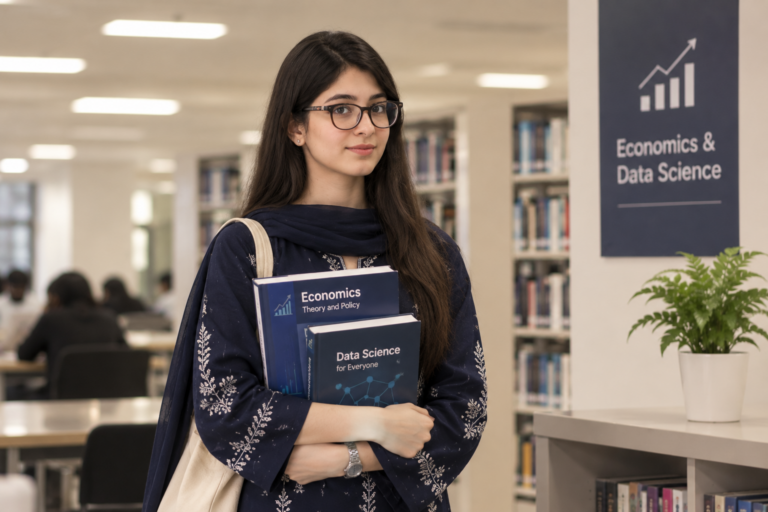

Undergraduate Program
Bachelor of Economics and Data Science
Become a part of one of the top-ranked universities in Pakistan
- Home
- Academic Hub
- Bachelor of Economics and Data Science
Introduction of Economics and Data Science
The Bachelor of Studies in Economics and Finance is a four-year undergraduate program that integrates economic analysis with the principles and practices of finance.
The program provides a strong foundation in microeconomics, macroeconomics, econometrics, public finance, international and development economicsalongside financial accounting, business finance, financial management, investment analysis, treasury management, risk management, banking and regulatory studies.
This combination is intended to prepare graduates to understand how economic conditions, policy choices and financial markets interact in contemporary organizations and economies.
The program is structured to develop both economic reasoning and financial decision-making capabilities.
Students advance from foundational economics, accounting, finance and statistics to intermediate and advanced economic analysis, mathematical economics, econometrics, financial economics, investment analysis, treasury and fund management, financial risk management and prudential regulation.
The curriculum also includes Islamic banking and finance, business analytics, research methodology, an internship and a capstone project. The program therefore provides a balanced academic and applied pathway for careers in financial institutions, corporate finance, investment, policy, regulation, research and related professional fields.
What Sets Us Apart
Our faculty blends creativity, education, and social impact—driving innovation, research, and community engagement to prepare future leaders and change-makers.

Vision
To develop high-quality graduates with integrated expertise in economics and finance who can contribute to sound financial decision-making, effective policy analysis and sustainable economic and institutional development.

Mission
Our program focuses on imparting technical expertise, critical thinking, and ethics. With a curriculum rooted in current cyber security trends and technologies like threat intelligence, block- chain, and machine learning, we ensure graduates are ready to tackle the field's evolving challenges. Our commitment to excellence in education, research, and service prepares students to excel and lead in the dynamic world of cyber security.
Program Objectives
(POs)
Upon successful completion of the BS (Economics and Finance) programme, graduates will be able to:
-
Economic & Financial Knowledge:
Apply core and advanced concepts in economics and finance to understand markets, institutions, policy and financial decision-making.
-
Analytical Skills:
Use quantitative, econometric and financial-analysis techniques to evaluate economic and financial information and develop evidence-based solutions.
-
Communication:
Communicate economic and financial analysis clearly to professional, academic, regulatory and stakeholder audiences.
-
Team Work:
Work effectively in teams and contribute to professional, research and applied financial assignments.
-
Ethical Reasoning:
Apply ethical judgment, professional integrity and responsible financial practices while considering regulatory, social and sustainability implications.
Program Learning Outcomes (PLOs)
On completion of the programme, students will be able to:
-
Demonstrate comprehensive understanding of economic theories, financial concepts, markets, institutions and regulatory frameworks.
-
Apply quantitative, econometric and financial-analysis tools to evaluate economic conditions, financial performance, investments, risk and policy issues.
-
Communicate financial and economic findings effectively through structured analysis, reports and professional presentations.
-
Integrate economics and finance knowledge in collaborative projects, internships and practical decision-making contexts.
-
Undertake independent research and continuous professional development while applying ethical and responsible practices in economic and financial decision-making.

PLOs and PEOs Mapping
| Mapping Between Program Learning Outcomes (PLOs) and Graduate Attributes (GAs) | |||||
| PLOs | Economic & Financial Knowledge | Analytical Skills | Communication | Team Work | Ethical Reasoning |
| 1. Economic and financial knowledge | X | X | |||
| 2. Quantitative, econometric and financial analysis | X | X | X | ||
| 3. Communication of economic and financial findings | X | X | |||
| 4. Integrated and collaborative professional application | X | X | X | X | |
| 5. Research, ethics and professional development | X | X | X | ||
Eligibility & Admission Criteria
Eligibility Criteria:
Pass the Higher Secondary School Certificate (involving 12 years of schooling) or an IBCC equivalent qualification in any group.
Admission Criteria:
Merit list will be prepared through(i) Aptitude test (70% weightage) and Interview (30%weightage).
Program Structure
The proposed BS (Economics and Finance) comprises 136 credit hours across general education, economics, finance, interdisciplinary/allied courses, supervised internship and capstone project requirements. The major component combines 57 credit hours of Economics with 27 credit hours of Finance, providing an integrated disciplinary structure of 84 major credit hours.
| Structure of BS (Economics and Finance) Program | Category: Courses (Credit Hours) |
| Total Credit Hours: 136 | General Education: 15 (34) |
| Total Courses: 49 | Major courses: 19 (57) + 9 (27) |
| Semesters: 8 | Allied/interdisciplinary courses: 4 (12) |
| Duration: Minimum 4 Years; Maximum 6 Years | Internship/field experience: 1 (3) |
| Course Load: Minimum 15 and maximum 20 credit hours | Capstone project: 1 (3) |
| Theory/Lab Contact Hours: 1 credit hour of theory = 1 contact hour; 1 credit hour of lab = 3 contact hours | Total: 49 (136) |
| Structure of Program | Category: Courses (Credit Hours) |
| Total Credit Hours: 136 | General Education: 15 (34) |
| Total Courses: 49 | Major Courses: Economics 19 (57) + Finance 9 (27) = 28 (84) |
| Total Regular Semesters: 8 | Interdisciplinary / Allied: 4 (12) |
| Minimum Duration: 4 Years | Internship / Field Experience: 1 (3) |
| Maximum Duration: 6 Years | Capstone Project: 1 (3) |
| Total: 49 (136) |
Scheme of Studies
| S# | COURSE CODES | CLASS | COURSE TITLE | CREDIT HOURS | PRE-REQ | CO-REQ | |
| SEMESTER 1 | |||||||
| 1 | GEN101 | GEN ED | Functional English | 3 + 0 | – | ||
| 2 | SEC1XX | MAJOR | Principles of Microeconomics | 3 + 0 | – | ||
| 3 | GEN110 | GEN ED | Islamic Studies (Religious Studies) | 2 + 0 | – | ||
| 4 | GEN103 | GEN ED | Introduction to Mathematics | 3 + 0 | – | ||
| 5 | GEN102 | GEN ED | Application of Information & Communication Technologies | 2 + 0 | – | ||
| GEN102-L | GEN ED | Application of Information & Communication Technologies (Lab) | 0 + 1 | ||||
| 6 | BAC212 | MAJOR | Financial Accounting | 3 + 0 | – | ||
| 7 | GEN120 | GEN ED | Pakistan Studies | 2 + 0 | – | ||
| 18 + 1 (19) | |||||||
| SEMESTER 2 | |||||||
| 1 | GEN108 | GEN ED | Academic and Professional Writing | 3 + 0 | GEN101 | ||
| 2 | GEN213 | GEN ED | Ideology & Constitution of Pakistan | 2 + 0 | GEN120 | ||
| 3 | SEC1XX | MAJOR | Principles of Macroeconomics | 3 + 0 | – | ||
| 4 | GEN210 | GEN ED | Introduction to Statistics | 3 + 0 | – | ||
| 5 | BIT211 | ALLIED | AI in Business | 3 + 0 | GEN102 | ||
| 6 | BFN151 | MAJOR | Business Finance | 3 + 0 | – | ||
| 7 | GEN105 | GEN ED | Environmental Studies and Sustainability | 2 + 0 | – | GEN105-L | |
| GEN105-L | GEN ED | Environmental Studies and Sustainability (Lab) | 0 + 1 | GEN105 | |||
| 19 + 1 (20) | |||||||
| SEMESTER 3 | |||||||
| 1 | TBA | GEN ED | Communication Skills | 2 + 0 | – | ||
| 2 | SEC2XX | MAJOR | Intermediate Microeconomics | 3 + 0 | – | ||
| 3 | BFN311 | MAJOR | Financial Management | 3 + 0 | BFN151 | ||
| 4 | GEN2XX | GEN ED | Entrepreneurship | 2 + 0 | – | ||
| 5 | BIF251 | MAJOR | Islamic Banking & Finance | 3 + 0 | – | ||
| 6 | GEN124 | GEN ED | Philosophy and Critical Thinking | 2 + 0 | – | ||
| 7 | GEN111 | GEN ED | Understanding of Holy Quran – I | 0 + 1 | – | ||
| 15 + 1 (16) | |||||||
| SEMESTER 4 | |||||||
| 1 | GEN2XX | GEN ED | Civics and Community Engagement | 2 + 0 | – | ||
| 2 | SEC2XX | MAJOR | Intermediate Macroeconomics | 3 + 0 | Principles of Macroeconomics | ||
| 3 | SIDXX | ALLIED | Business Statistics | 3 + 0 | GEN210 | ||
| 4 | SEC2XX | MAJOR | Overview of World Economy | 3 + 0 | Principles of Macroeconomics | ||
| 5 | BFN466 | MAJOR | International Finance | 3 + 0 | – | ||
| 6 | SFN2XX | MAJOR | Public Finance | 3 + 0 | – | ||
| 7 | GEN112 | GEN ED | Understanding of Holy Quran – II | 0 + 1 | GEN111 | ||
| 17 + 1 (18) | |||||||
| SEMESTER 5 | |||||||
| 1 | SEC2XX | MAJOR | Microeconomic Analysis | 3 + 0 | Intermediate Microeconomics | ||
| 2 | BFN490 | MAJOR | Central Banking and Monetary Policy | 3 + 0 | Intermediate Macroeconomics | ||
| 3 | BFN451 | MAJOR | Analysis of Financial Statements | 3 + 0 | – | ||
| 4 | SEC3XX | MAJOR | Mathematical Economics | 3 + 0 | – | ||
| 5 | SEC3XX | MAJOR | Econometrics | 3 + 0 | – | ||
| 15 + 0 (15) | |||||||
| SEMESTER 6 | |||||||
| 1 | SEC3XX | MAJOR | Macroeconomic Analysis | 3 + 0 | Intermediate Macroeconomics | ||
| 2 | SEC3XX | MAJOR | International Economics | 3 + 0 | Intermediate Microeconomics | ||
| 3 | SEC3XX | MAJOR | Development Economics | 3 + 0 | – | ||
| 4 | SEC3XX | MAJOR | Financial Economics | 3 + 0 | – | ||
| 5 | BFN467 | MAJOR | Investment Analysis and Portfolio Management | 3 + 0 | – | ||
| 6 | BIF461 | MAJOR | Islamic Economic Systems | 3 + 0 | – | ||
| 18 + 0 (18) | |||||||
| SEMESTER 7 | |||||||
| 1 | SIN4XX | INTERNSHIP | Internship | 3 + 0 | – | ||
| 2 | BFN469 | MAJOR | Treasury & Fund Management | 3 + 0 | – | ||
| 3 | BCM475 | MAJOR | Trade Agreements and Regional Economic Integration | 3 + 0 | – | ||
| 4 | BBA211 | ALLIED | Business Analytics | 3 + 0 | GEN210 | ||
| 5 | SRSXXX | MAJOR | Research Methodology | 3 + 0 | Business Statistics | ||
| 15 + 0 (15) | |||||||
| SEMESTER 8 | |||||||
| 1 | BEC4XX | MAJOR | Issues in Pakistan Economy | 3 + 0 | – | ||
| 2 | SIDXXX | ALLIED | Human Resource Development | 3 + 0 | – | ||
| 3 | BFN482 | MAJOR | Prudential Regulations of State Bank of Pakistan | 3 + 0 | – | ||
| 4 | BFN465 | MAJOR | Financial Risk Management | 3 + 0 | – | ||
| 5 | SCP4XX | CAPSTONE | Capstone Project | 3 + 0 | – | ||
| 15 + 0 (15) | |||||||
| TOTAL CREDIT HOURS | 136 | ||||||
Degree Award Requirements
The following minimum requirements are proposed for the award of Bachelor of Studies in Economics and
Finance:
1. All prescribed General Education courses, including Pakistan Studies and the applicable Islamic Studies / Religious Studies and Understanding of Holy Quran requirements, must be completed.
2. A total of 136 credit hours as prescribed in the approved scheme of studies must be completed.
3. A supervised internship / field experience of 3 credit hours must be completed.
4. A capstone project of 3 credit hours must be completed.
5. The student must meet the minimum CGPA requirement prescribed by Iqra University at the time of
completion of the degree.
6. The minimum duration of eight regular semesters spread over four years must be completed, subject to the approved maximum duration and University regulations.
Programme Notes
1. Non-Muslim students will take Comparative Religious Studies (2+0) in lieu of Understanding of Holy Quran – I and Understanding of Holy Quran – II courses, as applicable under University policy.
2. Non-Muslim students will take Religious Studies (2+0) in lieu of Islamic Studies; the applicable option should be specified at the beginning of the program.
3. Course codes shown with XX/XXX, and any code shown as TBA, are provisional and should be finalized
through the relevant academic and statutory approval process.
Key Features of the Programme
Integrated Economics and Finance: A balanced curriculum linking economic theory and policy with financial
markets, institutions and corporate financial decision-making.
Quantitative and Analytical Orientation: Strong coverage of statistics, mathematical economics, econometrics, business analytics and financial statement analysis.
Investment and Risk Focus: Courses in investment analysis, portfolio management, treasury, fund management and financial risk management strengthen market-oriented capabilities.
Banking and Regulatory Exposure: Coverage of central banking, monetary policy, Islamic banking and
finance, international finance and prudential regulation connects the curriculum with institutional practice.
Applied and Experiential Learning: Internship, research methodology and capstone work support application of academic learning to real financial and economic problems.
Ethical and Responsible Finance: The program promotes professional integrity, regulatory awareness and
responsible decision-making in financial and economic contexts.
Campuses Offering
Flexible learning designed for aspiring entrepreneurs
No posts found.
Ready to Join IU?
Take the first step towards an exceptional education that will transform your career and shape your future. Join thousands of successful graduates who started their journey right here.
Don’t just dream about your future — build it with us. Our admissions team is ready to guide you through every step of your journey.