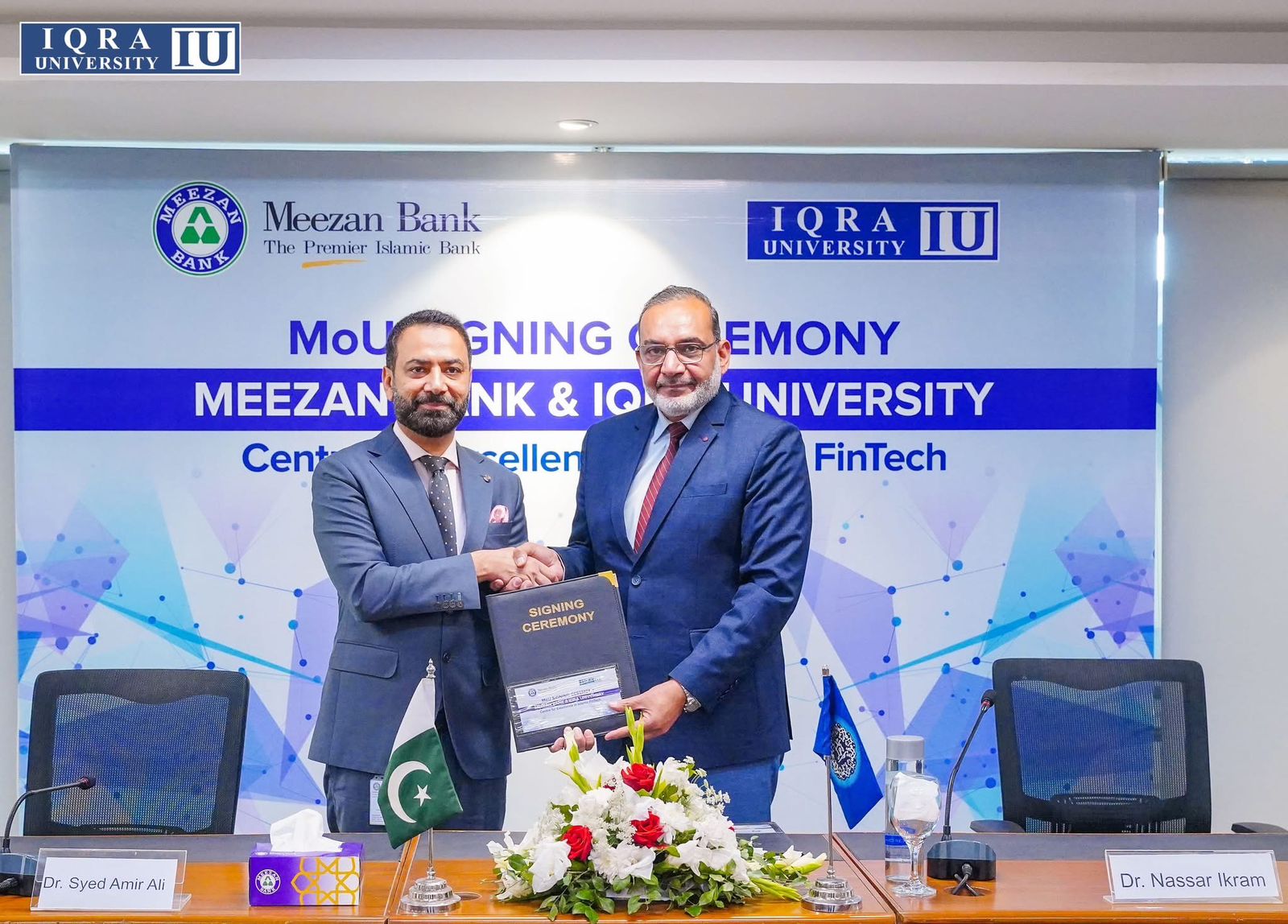
In a landmark step toward shaping the future of Islamic finance in Pakistan, Meezan Bank Limited and Iqra University have signed a Memorandum of Understanding (MoU) to establish the country’s first Centre of Islamic FinTech. The collaboration brings together Pakistan’s leading Islamic bank and a forward-looking academic institution to create a powerful bridge between Islamic finance, technology, and applied research.
The MoU was signed at Meezan Bank’s Head Office, Meezan House, in the presence of senior leadership from both organizations. The initiative marks a strategic shift from traditional academic-industry engagement toward a deeper, solution-driven partnership designed to address real-world challenges facing the financial sector.
A Vision Rooted in Ethics, Innovation, and Knowledge
Speaking on the occasion, Professor Dr. Nassar Ikram, Vice Chancellor of Iqra University, described the collaboration as a milestone not only for the two institutions but for Pakistan’s future. He lauded Meezan Bank’s role in transforming Pakistan’s banking landscape through ethical leadership, innovation, and resilience.
Dr. Nassar emphasized that sustainable innovation can only be achieved when academia and industry work in close alignment. “It is through universities that innovation is nurtured, knowledge is structured, and future-ready professionals are developed,” he noted. He further highlighted that Islamic finance, when anchored in research, technology, and global best practices, has the potential to evolve into a universally applicable financial model.
Acknowledging the collaborative effort behind the Centre, Dr. Nassar credited the joint leadership of Iqra University’s Faculty of Business Administration and Faculty of Engineering, Science and Technology, underscoring that the success of the Centre depends on true interdisciplinary ownership.
Why Islamic FinTech—and Why Now?
Syed Amir Ali, President and CEO of Meezan Bank, described the Centre of Islamic FinTech as both timely and necessary. Drawing from his experience across academia and industry, he stressed that while Islamic finance has seen significant academic development, the next phase of growth must come from its integration with modern technology.
“Globally, the most impactful economies are those where universities actively contribute applied research to industry,” he said, citing international examples where professors serve as innovators, advisors, and board members of leading technology companies. In contrast, he noted, Pakistan has long suffered from a disconnect between knowledge creation and practical application.
Rather than establishing another conventional center focused solely on Islamic economics or finance, the decision was made to pioneer a FinTech-driven model, combining Islamic financial principles with cutting-edge technologies such as artificial intelligence, machine learning, blockchain, and data science.
Focus on Digital Assets and Shariah-Compliant Innovation
A key pillar of the Centre’s work will be research and development in digital and virtual assets, an area gaining increasing attention from regulators and policymakers in Pakistan. With the government moving toward formal frameworks for digital assets and the establishment of regulatory authorities, the Centre aims to contribute scholarly and practical insights into Shariah-compliant digital currencies and tokenized financial instruments.
Syed Amir Ali highlighted that global payment systems are rapidly evolving, and digital asset infrastructure is likely to redefine remittances and cross-border transactions in the coming years. The Centre will explore models for stablecoins backed by real assets, multi-currency frameworks, and secure, ethical alternatives aligned with Islamic principles.
Applied Research, Industry Training, and Certification Programs
The Centre of Islamic FinTech will operate around three core objectives:
- Applied Research for Industry
The Centre will focus on solving real, industry-specific problems by developing technology-enabled, Shariah-compliant financial solutions. Emphasis will be placed on research that leads to implementation, policy input, and measurable impact rather than purely theoretical outcomes. - Capacity Building for Academia and Industry
Faculty members will be trained through direct exposure to industry practices, enabling them to bring current market realities into the classroom. This approach ensures that graduates are better prepared to meet local and global industry demands. - Islamic FinTech Certifications and Professional Training
The Centre will develop structured certification and postgraduate programs in Islamic FinTech, designed for banking professionals, technologists, and graduates from diverse disciplines. These programs will combine Islamic finance with practical technology skills, including AI, machine learning, blockchain, and programming fundamentals—an offering currently unavailable in Pakistan’s education landscape.
Driving Financial Inclusion and Economic Growth
Beyond education and research, the Centre aspires to play a transformative role in financial inclusion. By leveraging technology, it aims to support faster, more accessible, and more transparent financial systems that can bring underserved populations into the formal economy.
Both institutions reaffirmed their commitment to ensuring strong governance, operational leadership, and collaboration between business and engineering domains. Strategic oversight will be complemented by dedicated operational teams to ensure agility, relevance, and timely execution.
A Shared Commitment to Pakistan’s Future
The establishment of the Centre of Islamic FinTech reflects a shared belief that Pakistan’s economic future depends on reskilling, innovation, and ethical technological advancement. As industries worldwide undergo rapid digital transformation, this initiative positions Pakistan to not only adapt but lead in the domain of Islamic financial innovation.
With Meezan Bank’s industry leadership and Iqra University’s academic strength, the Centre is poised to become a national and potentially global hub for Islamic FinTech research, talent development, and policy influence.
As the MoU was formally signed, the message was clear: this partnership is not merely about institutions it is about investing in Pakistan’s future generations and building a financial ecosystem that is ethical, inclusive, and technologically advanced.